


TMEDA Catalyst (CAS 110-18-9): Properties, Applications and Benefits in Polyurethane Foam Systems

MOFAN TMEDA (N,N,N’,N’-tetramethylethylenediamine, CAS 110-18-9) is a high purity tertiary amine catalyst designed for commercial foam manufacturing systems. This versatile chemical compound acts as a balanced blowing and gelling catalyst during liquid polyol processing. Process engineers rely on its distinct properties to promote smooth surface skin formation in polyurethane foams. The additive delivers predictable reaction kinetic control across diverse polyurethane system applications. Process engineers and plant operators follow this technical formulation guide to optimize process parameters while maintaining strict operational safety standards. Procurement professionals also gain essential technical insights regarding material stability and reliable performance. This comprehensive guide supports precise quality management across facilities.
Key Takeaways
- MOFAN TMEDA is a high-purity catalyst. It balances blowing and gelling reactions in polyurethane foam production.
- The catalyst helps create smooth surface skins. It also maintains uniform cell density in soft, semi-rigid, and rigid foams.
- Engineers can combine TMEDA with MOFAN 33LV. This synergistic mix speeds up demold times and improves load capacity.
- Formulators must control catalyst dosage carefully. Overusing TMEDA speeds up cell growth too fast and weakens the foam core.
- TMEDA is a flammable liquid. Workers must store containers in cool spaces away from heat, moisture, and acids.
Chemical Properties of MOFAN TMEDA
Molecular Structure and Purity Standards
The basic chemical properties of mofan tmeda define its operational performance in polyurethane production. This molecule has the molecular formula C6H16N2. It displays a molecular weight of 116.2 g/mol. Commercial specification standards require a minimum purity of 98.00%. The liquid contains a maximum water content of 0.50%. Liquid purity maintains consistent chemical reactivity during processing. The compact chemical structure provides high tertiary amine density. This unique amine structure accelerates the core polyurethane reaction.
Formulators compare catalyst molecular weight to evaluate kinetic performance across formulations. The specific molecular structure gives this chemical compound distinct physical characteristics.
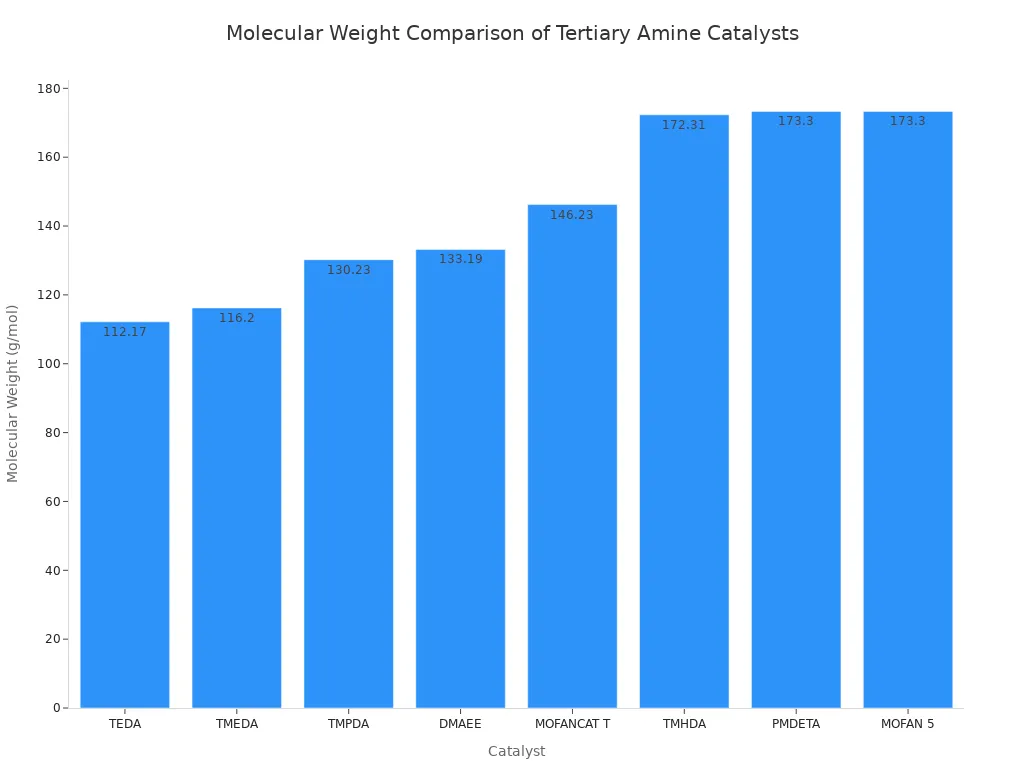
| Catalyst | Molecular Weight (g/mol) | Comparison to TMEDA |
|---|---|---|
| TMEDA | 116.2 | Reference |
| TEDA | 112.17 | Lighter |
| PMDETA | 173.30 | Heavier |
| MOFAN 5 | 173.3 | Heavier |
| TMPDA | 130.23 | Heavier |
| TMHDA | 172.31 | Heavier |
| DMAEE | 133.19 | Heavier |
| MOFANCAT T | 146.23 | Heavier |
The simple amine structure allows rapid mobility in polyol systems. This structural effect speeds up the gel reaction rate.
Solvency and Polyol Blend Stability
Physical characteristics include a clear, colorless-to-straw liquid appearance. The raw material releases a characteristic ammoniacal odor. Liquid additives exhibit 100% solubility in water, alcohol, and organic solvents. Full solvency improves overall liquid handling during raw material mixing. Chemical purity prevents active ingredient separation in storage tanks. The solubility profile directly improves final foam product properties.
Miscible with water, alcohols, esters, and most polyols
The strong solvent compatibility stabilizes complex polyol blends. Active amine sites generate a direct catalytic effect during liquid mixing. Broad solvency gives formulators predictable process control. Formulators observe a strong stabilizing effect throughout liquid component storage. Balanced chemical properties protect catalyst activity over extended production runs. This molecular structure ensures uniform curing in diverse applications.
Role as a Polyurethane Catalyst
Kinetic Balance of Gelling and Blowing
System formulators analyze kinetic rate parameters to select the ideal additive for target systems. MOFAN TMEDA acts as a polyurethane catalyst with balanced reactivity during polyurethane production. The active compound demonstrates moderate overall activity. This moderate behavior stabilizes gas evolution alongside polymer network formation. System formulators carefully balance kinetic parameters to prevent structural defect formation during processing. An excessive gelling rate causes premature solidification before full mold filling occurs. Conversely, an excessively high blowing rate creates pinholes and a coarse cell structure. MOFAN TMEDA provides an intermediate kinetic profile that addresses both issues simultaneously. Liquid processing remains stable across varying ambient production temperatures.
In polyurethane foam system design, the gelling activity rate constant k1 equals 4.19 (×10). The blowing activity rate constant k2 equals 1.14 (×10). This kinetic balance yields a distinct blowing/gelling ratio of 2.72 (×10⁻¹). Formulators evaluate these kinetic figures to design robust formulation strategies. For example, TEDA provides stronger gelling with a k1 of 10.90 and a k2 of 1.45. Conversely, PMDETA acts as a strong blowing catalyst with a k1 of 4.26 and a k2 of 15.90. BDMAEE also favors blowing, exhibiting a k1 of 2.99 and a k2 of 11.70. DMCHA exhibits lower overall activity with a k1 of 2.22 and a k2 of 0.83. The blowing/gelling ratio of TMEDA matches the 2.72 (×10⁻¹) ratio of DMAEMP. This balanced profile delivers key processing advantages in controlling cell rise and crosslinking kinetics during each polymer reaction phase.
Nucleophilic Isocyanate-Hydroxyl Activation
The compact molecular structure gives MOFAN TMEDA unique performance characteristics. Unshared electron pairs on the two nitrogen atoms drive the primary nucleophilic reaction interaction. This amine structure forms a temporary complex with electrophilic carbon atoms inside isocyanate functional groups. Consequently, this chemical structure lowers the overall activation energy of the urethane gelling reaction. Nitrogen electron coordination speeds up hydroxyl addition without causing rapid, uncontrolled expansion.
| Catalyst | Gelling Rate Constant (k1) | Blowing Rate Constant (k2) | Blowing/Gelling Ratio | Primary Catalytic Behavior |
|---|---|---|---|---|
| TMEDA | 4.19 (×10) | 1.14 (×10) | 2.72 (×10⁻¹) | Balanced Gelling/Blowing |
| TEDA | 10.90 | 1.45 | 0.13 | Strong Gelling |
| DMCHA | 2.22 | 0.83 | 0.37 | Moderate Gelling |
| PMDETA | 4.26 | 15.90 | 3.73 | Strong Blowing |
| BDMAEE | 2.99 | 11.70 | 3.91 | Strong Blowing |
The tertiary amine centers act as strong Lewis bases during polymerization. The spatial orientation of methyl substituents allows unhindered access to reacting organic species. This spatial arrangement accelerates secondary alcohol conversion rates without destabilizing liquid mixture cream times. Consequently, urethane network formation proceeds smoothly from initial liquid pouring through final mold demolding.
Process engineers leverage this specific activation mechanism to refine modern formulation strategies. The basic inductive effect increases local electron density around target active sites. This electronic effect promotes uniform surface skin curing across molded polyurethane parts. Furthermore, the molecular steric effect stabilizes phase separation during polymer network expansion. This localized steric effect regulates crosslinking density throughout the cure cycle. This combined catalytic effect ensures consistent core density, optimal physical properties, and smooth surface finishes. Formulators gain clear operational advantages through predictable cure profiles and controlled reaction exotherm behavior. Every primary reaction step benefits from this tertiary amine catalyst system.
Applications in Polyurethane Formulation


Polyurethane production relies heavily on targeted chemical additives to control material properties. MOFAN TMEDA serves as a versatile tertiary amine catalyst across diverse manufacturing applications. Its balanced reactivity profile supports various polyurethane foam systems, including soft foam, semi-rigid foam, and rigid polyurethane foams. Liquid systems benefit greatly from improved flow dynamics during processing. The active amine structure of this additive enhances surface cure without causing premature cell collapse. Formulators leverage these chemical characteristics across the global chemical industry to optimize overall system productivity. Proper balance between reaction steps provides consistent physical properties across every foam formulation. Technical teams rely on this catalyst to maintain uniform density throughout production cycles.
Rigid and Semi-Rigid Foam Systems
Formulators select specialized blowing and gelling agents to meet strict density targets. In rigid polyurethane foams, high-density foam formulation requires uniform cell expansion. Formulators design formulation strategies to integrate this specialized amine to optimize foam characteristics. The additive promotes rapid skin formation on outer mold walls. This fast-curing skin layer seals the expanding liquid core effectively. Consequently, processed panels achieve high structural integrity and clean surface finishes.
| System Type | Primary Application | Key Operational Role | Processing Effect |
|---|---|---|---|
| Thermoplastic Soft Foam | Footwear and interior trim | Skin formation promoter | Improves surface smoothness and wear resistance |
| Semi-Rigid Foam | Automotive dashboards and armrests | Cure rate accelerator | Balances dimensional stability with impact absorption |
| Rigid Polyurethane Foam | Refrigeration and insulation panels | Gelling/blowing stabilizer | Enhances core cell density and skin hardness |
Process engineers apply customized formulation strategies to stabilize semi-rigid systems. Automobile interior parts, such as armrests and dashboards, require smooth skin textures over dense structural cores. The active tertiary amine structure accelerates localized surface crosslinking. This localized reaction creates a durable skin layer while preserving interior cushioning properties. Moreover, thermoplastic soft foam systems gain distinct mechanical benefits. The balanced catalytic effect prevents surface pinholes, yielding consistent foam characteristics across complex geometric molds. Formulators fine-tune each polyurethane formulation to maximize mold filling efficiency and reduce scrap rates. Process engineers observe distinct processing advantages in high-throughput applications during fast-cycle production runs, ensuring repeatable manufacturing quality.
Auxiliary Use with MOFAN 33LV
Engineers frequently combine secondary catalysts to optimize processing parameters. Pairing this catalyst alongside MOFAN 33LV creates a powerful synergistic catalyst system. MOFAN 33LV supplies strong gelling action via triethylenediamine in dipropylene glycol. The steric effect of the tertiary amine refines early-stage blowing kinetics. This dual-catalyst formulation strategy achieves ideal foam rise profiles and shortens demold times significantly. Precise metering ensures optimal reaction synergy throughout the foam rise process.
The combined catalyst system reshapes cell morphology in flexible polyurethane foams. Smaller, more uniform cell windows develop during initial cream and gel phases. This stable structure increases load-bearing capacity while lowering shrinkage risks. Plant operators observe smooth rise curves during large-scale manufacturing runs. Furthermore, versatile applications extend into non-foam industrial sectors. The chemical compound acts as a high-performance accelerator in low-temperature epoxy-amine systems. Elastomer manufacturing benefits from predictable polymer network growth. Fast-curing polyurethane wood adhesives also leverage this unique amine structure to accelerate bond formation under ambient conditions. Chemical formulators adapt these formulation strategies to meet evolving processing requirements across multiple industrial applications, driving continuous innovation.
Processing Benefits and Storage Guidelines
Foam Cell Structure Optimization
MOFAN TMEDA improves the microcellular foam structure during polyurethane processing. The active amine catalyst provides a stabilizing effect on gas bubbles within the expanding polyurethane liquid matrix. Mixing proceeds smoothly without premature bubble collapse or gas loss. This mechanical effect leads to smaller, uniform cell sizes across finished foam products. System formulation testing ensures consistent quality, helping formulators achieve superior foam characteristics without surface skin defects. Process engineers rely on this balanced mechanism to optimize cell alignment in high-density foam lines.
Proper catalyst selection delivers key processing advantages in rigid foam production. The uniform cell structure enhances thermal insulation properties and overall physical strength. However, improper dosage creates distinct processing disadvantages. Excess loading accelerates cell growth too rapidly, disturbing the molecular structure and creating weak core density. This catalytic effect causes a localized heating effect and structural disadvantages in large foam blocks. Polyurethane formulation teams tune loading levels carefully to maintain ideal cure profiles.
Safety, Handling, and Packaging Specs
Plant operators must implement strict environmental and safety considerations during active chemical processing. MOFAN TMEDA displays unique performance traits that require dedicated containment protocols. Operators must monitor environmental humidity and environmental temperature inside storage facilities. Proper environmental management protects active amine purity from ambient moisture degradation.
| Aspect | Detail |
|---|---|
| Flammability Classification | Transport Hazard Class 3 (Flammable liquid); GHS Flammable liquids Category 2; Highly flammable liquid and vapor |
| Flash Point | 18 °C |
| Personal Protective Equipment | Chemical splash goggles; nitrile or neoprene gloves; long-sleeve lab coat; closed-toe shoes; NIOSH-approved organic vapor respirator for high airborne concentrations |
Careful operational safety prevents workplace injury around open liquid containers. Liquid spills create severe safety risks near high heat sources or electrical gear. Plant teams must store sealed containers in cool, dry, ventilated spaces. Stored container structure must stay far away from heat, moisture, static, and strong acids. Standard commercial supply options include 160 kg steel drums or customized packaging tailored according to specific customer requirements for industrial applications.
MOFAN TMEDA acts as a balanced tertiary amine catalyst for versatile polyurethane foam systems. Its chemical properties promote smooth surface skin development and efficient liquid processing across diverse manufacturing applications. Plant operators must maintain strict safety protocols due to its Class 3 flammability profile. Proper handling procedures and precise catalyst loading ratios protect foam formulation stability during active production runs. Chemical engineers gain distinct operational advantages by implementing MOFAN TMEDA in custom formulation strategies. This high purity catalyst delivers reliable kinetic control during complex curing reactions. Formulators achieve optimal performance by pairing this additive alongside MOFAN 33LV for high-volume polyurethane foam production lines.
FAQ
What main role does MOFAN TMEDA serve in foam production?
MOFAN TMEDA acts as a balanced blowing and gelling catalyst in polyurethane processing. The tertiary amine structure accelerates crosslinking while promoting smooth skin formation across molded products. Formulators rely on its predictable reactivity to achieve uniform cell growth in various applications.
Can MOFAN TMEDA be used in rigid polyurethane foams?
Yes, process engineers use MOFAN TMEDA in rigid polyurethane foams to improve skin hardness and seal expanding cores. Its localized catalytic effect promotes rapid skin curing. This performance improves overall dimensional stability across high-density insulation panels.
What processing disadvantages occur from using too much TMEDA?
Improper high dosage causes distinct processing disadvantages during production. Excessive amine loading speeds up cell expansion too rapidly. This strong catalytic effect destabilizes the fine cellular structure, creating weak core density and localized overheating in large blocks.
What environmental conditions affect TMEDA storage?
Operators must monitor environmental humidity and environmental temperature in chemical storage areas. TMEDA requires tightly sealed containers stored away from heat, ignition sources, moisture, and acids. Maintaining proper ambient control protects catalyst purity from moisture degradation before formulation.
Post time: Aug-21-2026