


|
Curing agent for Epoxy and polyurethane |
||||||
|
Number |
MOFAN GRADE |
Chemical Name |
Structural Formula |
Molecular Weight |
CAS Number |
Application |
|
1 |
MOFAN DBU |
1,8-Diazabicyclo[5.4.0]undec-7-ene |
 |
152.24 |
6674-22-2 |
A curing agent for epoxy resins and polyurethane. |
|
2 |
MOFAN SA-1 |
DBU/phenoxide salt |
 |
246.35 |
57671-19-9 |
High thermosensitive catalyst Activated at ca.40~50℃ |
|
3 |
MOFAN SA-102 |
DBU/2-ethylhexanoate salt |
 |
296.4 |
33918-18-2 |
High thermosensitive catalyst Activated at ca.50~60℃- |
|
5 |
MOFAN DB60 |
DBU / Phthalic Acid Salt |
|
318.37 |
97884-98-5 |
High thermosensitive catalyst Activated at 90℃ or higher. |
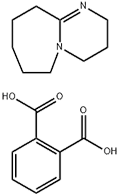
MOFAN DBU
I need a strong base catalyst for epoxy-anhydride curing systems. How does DBU perform?
DBU is a superb strong base catalyst that dramatically accelerates epoxy-anhydride reactions at 80–120°C, reducing cure time by 50% or more.
My epoxy adhesive has poor high-temperature strength. Can DBU improve it?
Yes, DBU promotes more complete crosslinking, raising the glass transition temperature (Tg) by 10–20°C compared to tertiary amines like DMP-30.
Is DBU suitable for latent one-component epoxy formulations?
Not as a pure base; it reacts with epoxy at room temperature. Use blocked DBU derivatives like MOFAN SA-1 or SA-102 for one-component systems.
My polyurethane elastomer requires a strong trimerization catalyst for improved heat resistance. Can DBU be used?
Yes, DBU is effective for isocyanate trimerization; use 0.1–0.5 phr to increase thermal stability.
What is the recommended dosage of DBU in a two-component epoxy-amine system at room temperature?
0.5–2 phr (based on epoxy resin); it dramatically reduces pot life, so use carefully for small parts.
My epoxy coating fails to cure completely at low temperature (5°C). Can DBU help?
Yes, DBU maintains catalytic activity even at low temperatures; increase to 2–3 phr for winter formulations.
Does DBU cause yellowing in clear epoxy castings?
Yes, it can cause discoloration; for optical clarity, use a less basic catalyst or a blocked version.
My carbon fiber composite prepreg needs a fast cure at 120°C. Is DBU suitable?
Yes, but because it is liquid and reactive at room temperature, store the prepreg frozen. Consider SA-102 for better latency.
Can DBU be used as a CO₂ absorbent or in polyurethane foam as a trimer catalyst?
Yes, DBU is used in CO₂ capture and as a trimer catalyst for PIR rigid foam (0.2–0.6 phr).
What is the shelf life of MOFAN DBU in an opened container?
12 months if stored dry and under nitrogen; it absorbs CO₂ from air forming carbonate, reducing activity.
MOFAN SA-1
I want a one-component epoxy adhesive with long storage stability at room temperature but fast cure at 40–50°C. Is SA-1 suitable?
Yes, MOFAN SA-1 is a blocked DBU salt that remains inactive below 40°C and activates rapidly at 40–50°C, giving 6+ months of room-temperature shelf life.
My epoxy structural film adhesive requires cure at 50°C for 30 minutes. What dosage of SA-1 is typical?
1–3 phr based on epoxy resin; it provides full cure within 30 minutes at 50°C without needing high-temperature ovens.
Can SA-1 be used in polyurethane one-component moisture-cure systems?
Not recommended; it is designed for epoxy. For PU, use a blocked amine like MOFAN SA-102.
My carbon fiber prepreg needs to be stored at room temperature for months. Does SA-1 provide good latency?
Yes, SA-1 gives excellent latency in epoxy-anhydride or epoxy-dicyandiamide systems; keep the formulation dry.
What is the activation temperature of SA-1?
Approximately 40–50°C. Below 40°C, the catalyst is essentially inert.
My electronic potting compound requires a low-temperature cure (50°C) to avoid damaging components. Is SA-1 the right choice?
Yes, SA-1 cures at 50°C without exotherm spikes; use 1.5–2.5 phr for complete cure in 1–2 hours.
Does SA-1 cause corrosion on copper or other metals?
No, phenoxide salts are generally non-corrosive; however, test for your specific metal contact.
My epoxy adhesive loses strength after thermal aging. Can SA-1 improve aging resistance?
The blocked DBU gives a more controlled cure, reducing internal stress and improving heat aging.
Can SA-1 be used with anhydride hardeners for high-temperature epoxy molding compounds?
Yes, SA-1 works well with anhydrides (e.g., MHHPA, THPA) for cures at 80–100°C, giving high Tg.
What is the typical formulation for a one-component epoxy paste with SA-1?
Epoxy resin (100 phr), anhydride hardener (80–100 phr), SA-1 (1–3 phr), and fillers as needed. Store below 30°C.
MOFAN SA-102
I need a one-component epoxy adhesive that cures at 50–60°C for automotive structural bonding. Why choose SA-102?
SA-102 has a slightly higher activation temperature (50–60°C) than SA-1, giving even better room-temperature stability while still curing at moderate heat.
My polyurethane one-component moisture-cure sealant requires a latent catalyst that activates at 60°C. Is SA-102 suitable?
Yes, SA-102 can be used in polyurethane systems as a blocked catalyst, especially for forced-cure applications at 60–80°C.
What is the advantage of SA-102 over SA-1?
SA-102 provides longer storage stability at room temperature (over 12 months) and a sharper activation window.
My epoxy prepreg for wind turbine blades requires cure at 60°C for 2 hours. What level of SA-102 should I use?
1–2 phr (on epoxy) combined with an appropriate hardener (dicyandiamide or anhydride).
Does SA-102 work with polyurethane casting systems to delay the reaction until heated?
Yes, it can be used to make one-component heat-curable polyurethane; typical dosage 0.5–1.5 phr.
My electronic encapsulation material needs a low-viscosity, one-component system. Is SA-102 compatible?
Yes, SA-102 is soluble in most epoxy resins and does not increase viscosity significantly.
What is the shelf life of a one-component epoxy formulation containing SA-102 at 25°C?
Typically 6–12 months in a sealed, dry container; avoid moisture and high ambient temperatures.
Can SA-102 be used to cure epoxy-phenolic resins for high-temperature coatings?
Yes, it accelerates the crosslinking between epoxy and phenolic resins at 80–100°C.
My adhesive fails to cure in thick sections due to heat sink. How does SA-102 help?
Its thermally triggered activation ensures cure even in large mass once the activation temperature is reached.
Is SA-102 toxic or hazardous?
It has low volatility but is a skin irritant; handle with gloves. It does not contain heavy metals.
MOFAN DB60
I produce one-component epoxy structural adhesives that need to be stable for months at 40°C and cure only above 90°C. Is DB60 the right choice?
Yes, MOFAN DB60 has an activation temperature of 90°C or higher, providing excellent latency even in hot climates.
My powder coating for metal parts requires a curing agent that activates at 120°C. Can DB60 be used in epoxy hybrid powders?
Yes, DB60 works well in epoxy powder coatings; typical level 1–3% of total resin, curing at 120–150°C.
What is the advantage of DB60 over SA-102 in prepreg applications?
DB60 allows storage at ambient temperature (even up to 40°C) without advancement, ideal for large-scale prepreg manufacturing.
My carbon fiber composite needs to be cured at 130°C for 30 minutes. How much DB60 should I use?
2–4 phr based on epoxy; it gives fast cure with minimal volatile release.
Can DB60 be used in polyurethane high-temperature curing systems?
Yes, as a blocked catalyst for heat-activated polyurethane crosslinking, e.g., in reactive hot-melt adhesives.
Does DB60 cause any discoloration in light-colored epoxy castings after high-temperature cure?
Minimal; it produces a pale amber color, less than many other latent catalysts.
My one-component epoxy paste has poor adhesion to aluminum after cure. Can DB60 improve adhesion?
Not directly; but because it allows a clean, high-temperature cure without premature reaction, adhesion can be enhanced.
What is the typical hardener combination with DB60 for a one-component epoxy?
Dicyandiamide (dicy) or anhydrides (MHHPA, nadic methyl anhydride) are commonly used.
My composite part has voids due to premature gelling. Will DB60 eliminate voids?
Yes, its high activation temperature allows complete resin flow and air evacuation before cure starts.
What is the shelf life of DB60 in a masterbatch?
Over 12 months when stored below 30°C in a dry, sealed container.