

Dibutyltin Maleate
Dibutyltin Maleate (DBTM) is a versatile organotin compound primarily used as a catalyst, heat stabilizer, and crosslinking agent in polymer and chemical industries.
Catalyst: For the production of polyurethane (PU) foams, elastomers, coatings, and adhesives, promoting the reaction between isocyanates and polyols. Also acts as a catalyst in esterification, transesterification, and condensation reactions, improving reaction efficiency in coating and resin production.
PVC Stabilizer: Serves as an excellent heat stabilizer for polyvinyl chloride (PVC) products, preventing discoloration and degradation during high-temperature processing, and enhancing the flexibility, transparency, and longevity of PVC products. It features no sulfur pollution and excellent long-term heat resistance.
Crosslinking Agent: Used as a crosslinking catalyst in silicone rubber, unsaturated polyester resins, and other polymer systems to enhance product hardness, mechanical properties, and thermal resistance.
Other Applications: Also used in the synthesis of organic compounds, as a functional additive in silicone and organotin chemistry, and potentially as a gasoline antiknock agent.


| Appearance | White to light yellow crystalline solid, flaky powder or white amorphous powder; may appear as light yellow to yellow to orange clear liquid in some formulations |
| Purity,% | ≥98 |
| Tin content (Sn), % | 32-33 |
| Melt point, ℃ | 90-130 |
| Flash Point, ℃ | 204 |
| Tin content (Sn), % | 32-33 |
| Flash Point, ℃ | 204 |
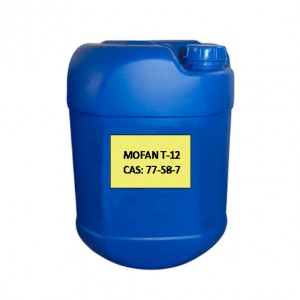
25kg/drum or according to customer needs.
H302: Harmful if swallowed.
H313: May be harmful in contact with skin.
H314: Causes severe skin burns and eye damage.
H317: May cause an allergic skin reaction.
H330: Fatal if inhaled.
H341: Suspected of causing genetic defects.
H360: May damage fertility or the unborn child.
H372: Causes damage to organs through prolonged or repeated exposure.
H411: Toxic to aquatic life with long-lasting effects.

Pictograms
| Signal word | Danger |
| UN number: | 3146 |
| Class: | 6.1 |
Handling
Wear appropriate personal protective equipment (PPE): gloves, safety goggles, face protection, and respiratory protection (especially in poorly ventilated areas) to avoid skin, eye contact, and inhalation of dust or vapors.
Avoid contact with skin, eyes, and clothing. In case of contact with skin or hair, immediately remove all contaminated clothing and rinse the affected area thoroughly with water or shower; wash contaminated clothing before reuse. In case of eye contact, rinse immediately with plenty of water for at least 15 minutes, remove contact lenses if easily removable, and continue rinsing.
Do not eat, drink, or smoke during handling. Wash hands thoroughly after handling and before eating, drinking, or smoking.
Handle in a well-ventilated area (preferably outdoors or in a fume hood) to prevent dust or vapor accumulation. Do not breathe dust, mist, or vapors.
Obtain special instructions before use and do not handle until all safety precautions have been read and understood. Collect any spillage promptly to avoid environmental contamination.
Storage
Store in a cool, dry, well-ventilated warehouse. Recommended storage temperature: 2 – 8 °C under inert atmosphere (nitrogen or argon); alternative: 5 – 30 °C or room temperature in a cool, dark place (< 15 °C).
Keep the container tightly closed when not in use to prevent moisture absorption, contamination, and dust emission. Store in a locked area to restrict access.
Store away from heat, sparks, open flames, and strong oxidizing agents (e.g., peroxides, nitric acid). Avoid contact with strong acids and bases due to incompatibility.
Do not store together with food, feed, or pharmaceuticals to prevent cross-contamination.