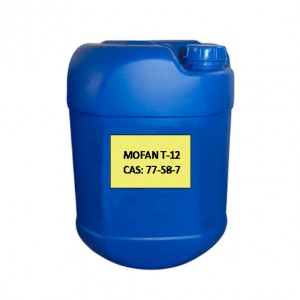
MOFAN

products

Dioctyltin Dilaurate (DOTDL)

  • MOFAN Grade:: MOFAN T2801S
  • Competitor Brand:: TIB KAT 216,SONGSTAB™TL-710
  • Chemical name:: Dioctyltin Dilaurate
  • Cas number:: 3648-18-8
  • Product Detail

    Product Tags

    Description

    Dioctyltin dilaurate is a white solid that turns into a pale yellow transparent liquid when melted. This product exhibits excellent lubricity, weather resistance, transparency, no sulfur staining, and no exudation. Its lubricity is the best among organotin compounds, while its thermal stability is relatively low in this category. It possesses initial coloration and is suitable for use in combination with fluid-type organotin and barium-cadmium soap stabilizers, demonstrating a synergistic effect.

    Application

    • Used for PVC Package as Heat-stabilizer for Food and Drug
    • Lubricant for Hard transparent food packaging material
    • Catalysts for Medical silicone rubber

    图片10
    图片8
    图片7

    Typical Properties

    Appearance Yellow liquid
    Tin content (Sn), % 15-16
    Density g/cm3 1.069
    Chrom (Pt-Co)  ≤200
    Melt point, ℃ 17-18

    Commercial specification

    Tin content (Sn), % 15-16

    Package

    25kg/drum or according to customer needs.

    Hazard statements

    H371: May cause damage to organs (immune system; reversibleeffect) (Oral)

    Label elements

    图片11

     Pictograms

    Signal word  Warning

     Not regulated as dangerous goods.

    Handling and storage

    Precautions for safe handling:
    For non-emergency personnel:
    Do not breathe vapor. Handle in well ventilated areas. Eliminate all sources of ignition, and do
    not generate flames or sparks. Take precautionary measures against static discharges.
    Advice on general occupational hygiene:
    Do not eat, drink and smoke in work areas. Wash hands after use. Remove contaminated clothing
    and protective equipment before entering eating areas.
    Conditions for safe storage, including any incompatibilities:
    Store in a cool, dry, well ventilated area away from heat and direct sunlight. Keep containers tightly
    sealed.
    Specific end use(s): Not applicable.

    FAQ

    I produce polyurethane elastomers for food-contact applications (e.g., rollers). Is T2801S a non-toxic alternative to DBTDL?

    Yes, dioctyltin dilaurate has lower toxicity and is approved for indirect food contact; use 0.05–0.2 phr.

    My one-component moisture-cure adhesive has poor shelf life with DBTDL. Can T2801S extend it?

    Yes, dioctyltin catalysts are less prone to premature hydrolysis, offering 2–3 months longer storage stability.

    What is the recommended dosage in polyurethane RIM (reaction injection molding) for automotive parts?

    0.1–0.3 phr; it provides fast demold and good surface finish.

    Can T2801S be used in silicone condensation curing (RTV-2) systems?

    Yes, it is an effective catalyst for alkoxy-or oxime-silane crosslinking.

    My PU sealant cures too slowly in cold weather. How much T2801S should I add?

    Increase to 0.3–0.5 phr; it remains active down to 0°C.

    Is MOFAN T2801S compatible with low-emission PU formulations for interior automotive?

    Yes, it has low volatility and does not contribute to fogging.

    What is the difference between T2801S and MOFAN T-12 (DBTDL)?

    T2801S has a longer alkyl chain (octyl vs butyl), making it less toxic and slightly less active per gram.

    My polyurethane coating has bubbles due to fast CO2 release. How to adjust?

    Reduce T2801S to 0.05 phr and add a defoamer; slower cure allows bubbles to escape.

    Can T2801S be used as a heat stabilizer for PVC?

    Not directly; it is mainly a PU catalyst, but dioctyltin derivatives are used as PVC stabilizers.

    How should I store T2801S?

    Liquid at room temperature; store in a cool, dry place; avoid moisture.


  • Previous:
  • Next:

  • Write your message here and send it to us

    Leave Your Message